
Interlocking Concrete Bricks & Blocks for Strong, Scalable Construction
Detachment 5 Block | United States Supply
Interlocking concrete blocks aren’t just another masonry option they’re a structural system built for speed, mass stability, and real jobsite performance.
At Detachment 5 Block, we supply precast interlocking concrete blocks across the United States for contractors who need reliable material that performs under load, installs fast, and holds its structure without mortar or curing delays.
These systems are used where traditional masonry slows projects down — retaining walls, industrial containment, commercial grading, and large-scale infrastructure builds.
Built for Modern Construction, Not Just Standard Masonry
Interlocking cement blocks are engineered as a connected structural system, not individual masonry units. Once placed, each block locks into position and becomes part of a mass structure designed to resist movement through weight and geometry — not mortar.
This makes them especially useful in environments where speed and structural reliability matter more than finish work.
Detachment 5 Block supplies these systems for active construction sites across the U.S., where contractors need material that can go from delivery to installation without delays, curing time, or complex setup.
In practical terms, it means:
- faster stacking on site
- fewer skilled labor requirements
- immediate structural stability after placement
- reduced downtime between project phases
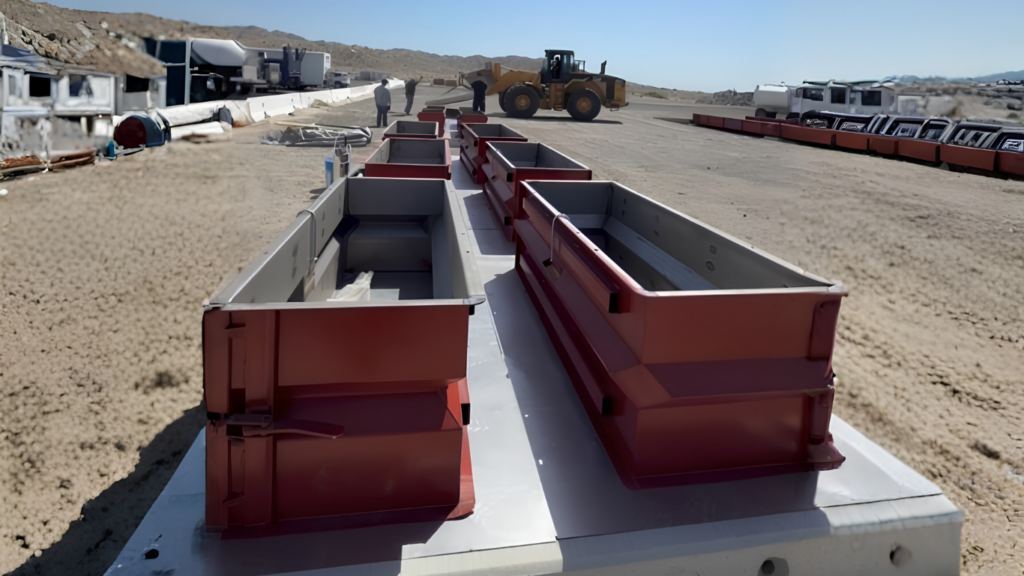
Technical Specifications: Size, Weight, and Compressive Strength
Engineering decisions cannot rely on vague estimates. True structural integrity starts with material density, tight dimensional tolerances, and high compressive strength.
Our interlocking concrete blocks are cast in a highly controlled environment using graded aggregates to eliminate the air voids that cause cracking under long-term pressure.
Block Dimensions and Weight Matrix
To plan your freight and on-site crane or excavator lifting needs, use the table below for standard block profiles:
Block Type | Dimensions (L×W×H) | Approximate Weight | Ideal Application |
Full Block | $5 \times 2.5 \times 2.5\text{ ft}$ | $4,800\text{ lbs}$ | Retaining walls, bulk storage bays |
Half Block | $2.5 \times 2.5 \times 2.5\text{ ft}$ | $2,400\text{ lbs}$ | Wall ends, stepped transitions |
Low-Profile | $5 \times 2.5 \times 1.25\text{ ft}$ | $2,400\text{ lbs}$ | Caps, precise vertical adjustments |
Performance Metrics
- Compressive Strength: Our blocks exceed structural standards, testing at 3,000 to 4,000 PSI at 28 days depending on the project spec.
- Durability (ASTM C67): Tested to withstand over 50 cycles of severe freeze-thaw testing with less than 1% mass loss, keeping the structure intact even in extreme northern climates.
- Aggregates and Mix: Sourced in line with ASTM C33 standards to guarantee consistent tensile and structural performance across every batch.
Interlocking Concrete Blocks for Walls, Barriers, and Heavy-Duty Builds
Interlocking blocks for walls are widely used in construction environments where soil pressure, load resistance, and adaptability matter.
These systems are not limited to one application they function as modular structural units that can be configured based on project needs.
Retaining Walls & Soil Support Systems
Used in both residential grading and commercial earth retention, these blocks handle lateral soil pressure by relying on mass and interlock geometry rather than mortar bonding.
They are commonly used for:
- slope stabilization
- site elevation control
- permanent and semi-permanent retaining structures
Industrial Barriers & Site Protection
On industrial sites, interlocking blocks are used to create heavy-duty containment systems that can handle impact, equipment movement, and shifting site layouts.
Common uses include:
- security barriers
- equipment separation zones
- temporary containment walls
- operational safety boundaries
Agricultural & Utility Use
In agricultural environments, interlocking systems are used for bulk material control and structural containment.
Typical applications include:
- silage storage walls
- feed and material bins
- flood and debris control barriers
- utility yard containment structures
Interlocking Concrete Blocks for Sale Across the United States
Detachment 5 Block supplies interlocking concrete blocks for sale across the United States with a focus on contractor-driven logistics and bulk fulfillment.
This is not retail supply it’s project-based material distribution.
Orders are structured around:
- jobsite location
- block type and application
- required volume (linear footage or layout-based estimates)
Supply is coordinated to support both single-site builds and multi-phase commercial projects.
Delivery is scheduled directly to job sites, staging yards, or storage locations depending on project requirements.
The focus is consistency — ensuring contractors aren’t left dealing with uncertain availability or fragmented sourcing.
Why Contractors Choose Interlocking Cement Blocks Over Traditional Masonry
There’s a clear reason interlocking cement blocks are replacing traditional masonry systems in large-scale builds.
They remove several constraints that slow down conventional construction.
Faster Installation Without Mortar
Blocks are dry-stacked, meaning there is no curing time or mixing required. Once placed, the structure becomes load-bearing immediately.
Reduced Labor Dependency
Because the system is modular and interlocking, fewer specialized masonry skills are required on site, which simplifies crew requirements.
Stack-and-Lock Structural Stability
Each unit locks into place, creating a stable mass structure that resists lateral movement without mortar joints weakening over time.
Reusable and Reconfigurable Systems
Unlike permanent masonry, interlocking systems can be disassembled and reused in new layouts or projects when needed.
Lower Long-Term Project Cost
Cost savings come from:
- reduced labor time
- faster installation cycles
- lower equipment downtime
- simplified project staging
Interlocking Cinder Block Walls for Industrial Strength Projects
Interlocking cinder block walls are used in environments where durability, impact resistance, and long-term stability are critical.
These systems are commonly found in industrial yards, infrastructure projects, and commercial facilities where structural failure is not an option.
Their strength comes from system design — not just material mass.

Reinforced Stacking Systems
Each layer locks into the next, creating a unified wall structure that resists shifting under load, vibration, and ground pressure.
Resistance to Weather and Freeze–Thaw Cycles
These blocks are designed for outdoor exposure and maintain structural integrity through seasonal temperature changes, heavy rainfall, and long-term environmental stress.
Use in Infrastructure and Commercial Builds
Common applications include:
- perimeter security walls
- retaining structures for infrastructure projects
- industrial containment systems
- heavy-load separation barriers
Engineering & Technical Strength You Can Rely On
This system is built on precast concrete engineering standards used across U.S. construction environments.
Real-World Block Weight and Load Behavior
Standard units typically range from 1,800 to 4,000+ lbs per block, depending on size and configuration. This mass contributes directly to wall stability in gravity-based systems.
Compressive Strength and Concrete Performance
Concrete mixes are designed to achieve approximately 2,500 to 4,000 PSI compressive strength, depending on application requirements and structural design needs.
Aggregate Density and Material Composition
Crushed stone aggregates are used to control density, reduce voids, and improve long-term durability under sustained load and environmental exposure.
Interlocking Geometry and Lock Systems
Tongue-and-groove or lug-style locking systems keep blocks aligned during stacking and reduce lateral movement under pressure.
Structural Load Distribution
Instead of relying on mortar joints, loads are distributed across multiple contact points throughout the system, improving stability in retaining and stacked wall applications.
U.S. Construction-Ready Manufacturing Standards
Blocks are produced to align with standard precast concrete testing practices used in the United States, supporting consistent performance across commercial and industrial builds.
Ordering & Supply Process for Contractors
The ordering process is designed around real construction workflows, not retail checkout systems.
Project-Based Quote System
Pricing is based on:
- wall length or project footprint
- block type and application
- delivery location and access conditions
Bulk Order Fulfillment
Orders are structured for:
- pallet shipments for smaller jobs
- full truckload delivery for large-scale projects
- multi-load scheduling for phased builds
Jobsite Offloading Requirements
Depending on site conditions, unloading typically requires:
- forklift (most common)
- telehandler or excavator
- crane support for specialized placements
Freight and Delivery Coordination
Delivery is arranged using flatbed or step-deck trucks depending on load size and site access requirements.
Lead Times and Scheduling
Lead times vary based on:
- order volume
- production scheduling
- delivery distance
All timelines are communicated upfront so contractors can align labor and site readiness without disruption.
Why Detachment 5 Block
Detachment 5 Block is built for one purpose — supplying interlocking concrete systems that perform reliably on real U.S. job sites.
- U.S.-focused supply coordination
- contractor-first ordering structure
- consistent bulk availability
- logistics built for heavy construction materials
- systems designed for real structural use, not retail display
FAQs
What are interlocking concrete bricks used for?
They are used to build structural walls, retaining systems, barriers, and containment structures without mortar, making them ideal for fast and scalable construction.
Are interlocking cement blocks stronger than regular blocks?
In many structural applications, yes. Their interlocking design distributes load across the entire system, improving stability compared to traditional mortar-based masonry.
Can interlocking blocks be used for retaining walls?
Yes. They are commonly used for retaining walls because they handle lateral soil pressure effectively through mass and interlock stability.
Do interlocking concrete blocks require mortar?
No. They are dry-stack systems designed to lock mechanically, eliminating the need for mortar or curing time.
Are interlocking concrete blocks available in bulk in the U.S.?
Yes. Detachment 5 Block supplies bulk quantities across the United States with project-based delivery and logistics coordination.