
Stackable Concrete Barrier Blocks for Sale Across the U.S.
Heavy-duty interlocking concrete blocks for retaining walls, material containment, and site barriers are available in bulk with fast delivery.
You’re not here to browse; you need blocks that are ready to ship and built to handle real job-site pressure. At Detachment 5 Block, we supply stackable concrete barrier blocks at scale for contractors, site managers, and bulk buyers across the United States. Whether you’re building a stacked block retaining wall, setting up material bins, or securing a jobsite, we’ve got inventory ready, and logistics dialed in.
Stackable Concrete Blocks Built for Real Jobsite Use
These aren’t decorative pieces, they’re built for tough environments where things need to hold up without constant maintenance.
Our stackable concrete blocks are used on active jobsites every day for building stackable retaining wall blocks, storage bays, and heavy-duty barriers. Each unit is designed to handle weight, pressure, and repeated use without breaking down.
The interlocking design keeps everything aligned as you stack, so crews can move fast without worrying about shifting or instability. Whether you’re setting up a stacked block retaining wall or organizing materials with concrete stacking blocks, the system stays solid under load. No curing time. No complex installs. Just place, stack, and get on with the job.
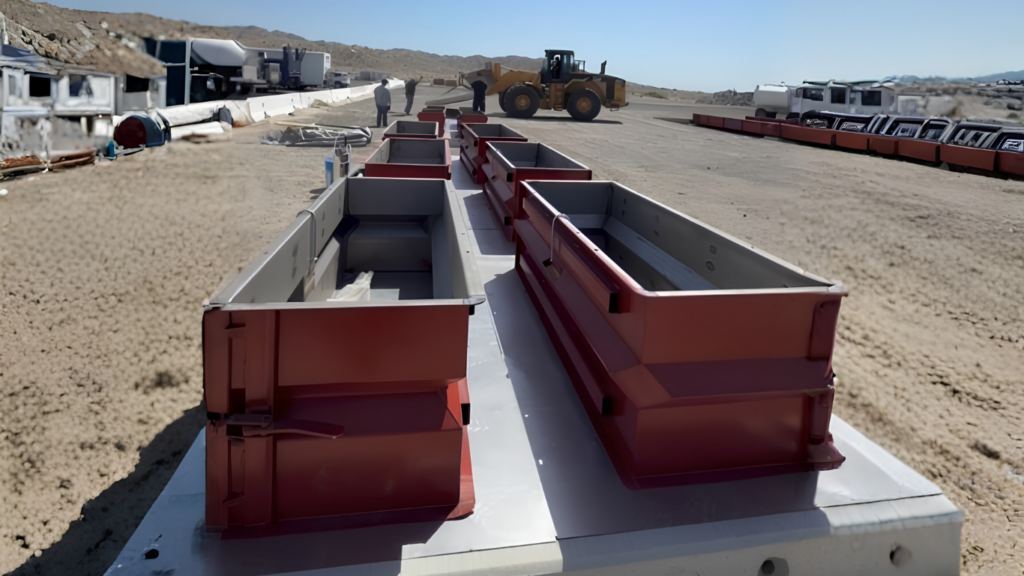
Available Concrete Bin Blocks & Standard Sizes
We keep sizing simple and jobsite-friendly. No guesswork just solid, consistent blocks you can plan around.
Our concrete bin blocks for sale are produced in standard dimensions that work across retaining walls, containment systems, and barrier setups.
Common Block Sizes
Block Size (L × W × H) | Approx. Weight | Typical Use |
6′ × 2′ × 2′ | 3,000–4,000 lbs | Primary retaining walls, large barriers |
4′ × 2′ × 2′ | 2,000–2,800 lbs | Mid-size walls, bin structures |
2′ × 2′ × 2′ | 1,000–1,500 lbs | Corners, top layers, adjustments |
Interlocking System
Every block is designed to lock into place using a tongue-and-groove or V-interlock system.
- Keeps rows aligned during stacking
- Reduces shifting under load
- Adds stability without mortar or fasteners
That’s what makes stackable concrete blocks so efficient once they’re placed, they hold their position even under heavy use.
Built for Retaining Walls, Containment & Barrier Systems
These blocks aren’t one-purpose. They’re used across multiple industries because they solve real jobsite problems fast.
Stackable Retaining Wall Block Systems
Perfect for building a stacked block retaining wall without pouring concrete or waiting on cure time.
- Gravity-based stability no footing required in most cases
- Fast setup using standard equipment
- Easy to expand, adjust, or reconfigure
Whether it’s temporary or permanent, stackable retaining wall blocks give you a solid structure without slowing down the project.
Material Containment & Bin Walls
Used heavily for storage and separation of bulk materials.
- Aggregates, sand, gravel
- Scrap, recycling, demolition debris
- Agricultural or industrial materials
The weight and interlock system handle high lateral pressure, making them ideal for long-term containment.
Site Barriers & Perimeter Control
When you need to define space or protect areas, these blocks do the job quickly.
- Traffic separation
- Equipment zones
- Safety perimeters
They can be used as temporary or permanent barriers, depending on your setup, and moved when the job changes.
How the Interlocking System Works in Real Builds
This is where stackable concrete blocks really prove their value. You’re not just stacking weight, you’re building a system that locks together and stays put.
How the Blocks Stack
Each block is cast with a tongue-and-groove or V-interlock design. When you place one block on top of another:
- The top block drops into position
- The interlock keeps it from sliding
- rows stay aligned without constant adjustments
No mortar. No anchors. Just precise placement and stacking.
How Alignment Stays Consistent
Once the first course is level, the rest follow naturally.
- interlock guides positioning
- reduces shifting during stacking
- keeps walls straight across long runs
That’s why crews can move fast with concrete stacking blocks, less measuring, less correcting.
Stability Comes from Weight + Design
Each unit weighs thousands of pounds, so stability isn’t just from the interlock; it’s from mass.
- blocks resist movement under pressure
- Gravity holds the structure together
- ideal for heavy-duty applications like stackable retaining wall blocks
Real-World Build Scenarios
- Corners
Blocks can be rotated and overlapped to create tight, stable corners without special units. - Stepped Walls
Perfect for uneven ground, just step back each layer as needed while maintaining interlock contact. - Multi-Level Stacking
Used for higher walls or deep containment bins. The interlocking pattern helps distribute load across layers.
You’re not building piece by piece; you’re assembling a modular system that holds under real jobsite pressure.
Delivery, Freight & On-Site Placement
This is the part most suppliers don’t explain, and it’s usually what slows projects down. We keep it clear so you know exactly what to expect.
How Many Blocks Per Truck?
Typical ranges (depending on size and weight):
- 6’ blocks: ~8–12 per load
- 4’ blocks: ~12–18 per load
- 2’ blocks: ~18–30 per load
Final counts depend on:
- block dimensions
- total weight limits
- delivery distance
Weight Per Load
- Standard flatbed capacity: 40,000–48,000 lbs
- Heavier blocks = fewer per load
- Lighter configurations = more efficient hauling
We help you plan loads based on your project not guesswork.
Delivery Coordination
- Scheduled around your jobsite timeline
- Flexible drop-off planning
- Bulk shipments available for large projects
Unloading Requirements
Before delivery, you’ll want the right equipment on-site:
- Forklift or telehandler (most common)
- Crane or boom truck (for precise placement or tight access areas)
Blocks come with lifting points, so handling is straightforward with standard equipment.
Jobsite Access Considerations
To avoid delays, make sure:
- trucks have clear entry and exit paths
- Ground conditions can handle heavy loads
- The unloading area is prepared in advance
If access is tight or conditions are tricky, we’ll help plan the best approach.
This is what separates a smooth delivery from a problem job.
We don’t just ship blocks we help you get them placed and ready to use without delays.
Why Contractors Partner with Detachment 5 Block
Most suppliers can drop off concrete blocks. The real difference shows up once the job starts whether everything arrives on time, stacks clean, and stays consistent from the first layer to the last.
Reliable Volume and Continuity
We don’t oversell inventory or leave you scrambling mid-project.
Production is planned around your total job volume so you’re not dealing with surprise shortages halfway through a build. If your schedule is tight, the supply stays tight with it.
Consistent Fit and Alignment
Every block is cast to the same specs, so it behaves the same on-site load after load.
That matters when you’re building tall walls or long runs where even small inconsistencies turn into bigger problems.
- Clean stacking with no forcing or adjustment
- Tight interlock that holds its position naturally
- Stable vertical alignment across tiers
Jobsite-Ready Logistics
We don’t just ship and disappear.
Delivery is planned around how your site actually runs — access points, equipment, timing, all of it.
Whether it’s boom truck placement or staged deliveries to fit tight jobsite space, we coordinate it so material shows up when it can actually be used.
Built for Real-World Load and Pressure
They’re used for:
- Gravity retaining walls that rely on weight and stability, not mortar or curing time
- Material containment bins that handle constant impact from loaders and heavy equipment
- Site barriers and perimeter control, where durability and mass matter from day one
Get a Quote for Stackable Concrete Blocks
If you already know what you need, getting a quote is quick and straightforward.
Start by sharing the quantity, whether that’s a specific number of blocks or full truckloads. If you know the block size, include it, but if not, we can figure that out with you. Then just let us know the delivery location, whether it’s a jobsite or storage yard. That’s all we need to build a proper price and plan the delivery the right way.
What Happens Next
You’ll hear back fast no sitting around waiting days for a number. Quotes are built around your actual project needs, not generic estimates. You’ll also get clear delivery details upfront, so you know exactly how the material will arrive, when it’s coming, and what to expect on-site.
If you’re pricing stackable concrete barrier blocks or looking for concrete bin blocks for sale, just send the details over. We’ll keep it simple and give you a straight answer without the back-and-forth.
FAQs
What are stackable concrete barrier blocks?
They are precast interlocking concrete units used to build retaining walls, material bins, and site barriers.
They stack without mortar and lock into place using a tongue-and-groove or interlocking design.
How much do stackable concrete blocks weigh?
Most stackable concrete blocks typically range from 1,000 lbs to 4,000 lbs per unit, depending on size.
Heavier blocks are used for retaining walls and high-pressure containment setups.
Can these blocks be used for retaining walls?
Yes. Stackable retaining wall blocks are commonly used for gravity-based retaining walls.
Their weight and interlocking design allow them to hold soil pressure without additional reinforcement in most standard applications.
Do I need a foundation for stacked block retaining walls?
In most cases, no concrete footing is required.
A compacted, level base (like crushed stone or prepared aggregate) is usually enough to support a stable stacked block retaining wall.
How are the blocks delivered and unloaded?
Blocks are delivered by flatbed trucks or similar freight depending on quantity.
Unloading is typically done using a forklift, telehandler, or crane since each unit is heavy and designed with lifting points for safe handling.
Are concrete bin blocks reusable?
Yes. Concrete bin blocks for sale are built for repeated use.
They can be dismantled, relocated, and restacked multiple times without losing structural integrity, making them ideal for temporary or evolving jobsite setups.